
Why Outside Air Reduction is the Biggest Cost Saving Opportunity for Indiana Buildings
The Hidden Cost of Outside Air
Most buildings in Indiana are designed to bring in large amounts of outside air to maintain indoor air quality.
But outside air is not always clean air.
Outdoor air can contain:
- Fine particulate matter (PM2.5)
- Ozone
- Vehicle emissions
- Industrial pollutants
- Humidity
- Seasonal allergens
- Wildfire smoke
- Volatile organic compounds (VOCs)
In many cases, buildings are spending large amounts of energy conditioning outside air that still requires filtration and contaminant control before it is acceptable for occupants. In some situations, increasing outside air can actually increase contaminant exposure unless it is properly filtered and managed.
At the same time:
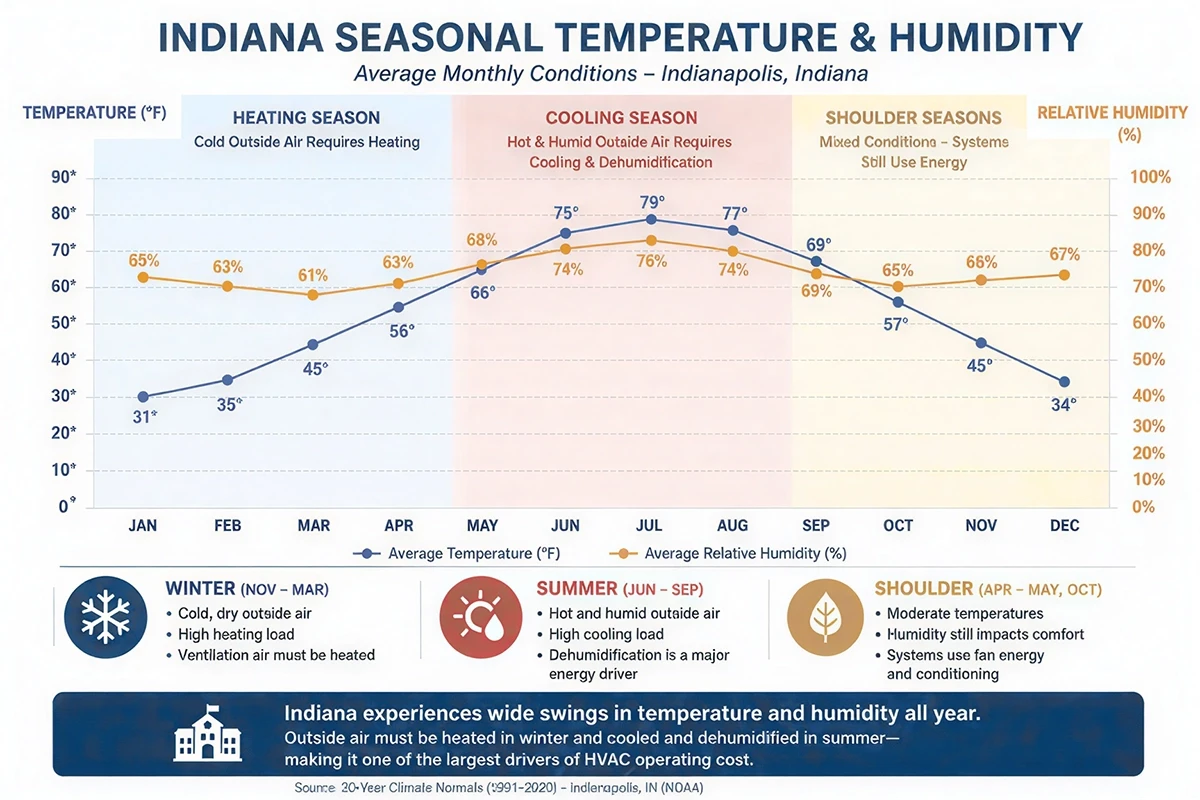
- Cold winter air must be heated
- Hot, humid summer air must be cooled and dehumidified
- That air must be moved through the HVAC system year-round
For K-12 schools, universities, and public buildings, outside air becomes one of the largest drivers of:
- HVAC operating cost
- Humidity issues
- Energy consumption
- Maintenance burden
The result: Most buildings are spending more than necessary without actually verifying air quality performance.
IAQP and the Impact of ASHRAE 62.1-2022


Fixed Outside Air
(VRP-Based Design)

Demand-Controlled Ventilation (DCV)

Outside Air Reduction (IAQP / Ventilation Optimization)
The reality: Very few buildings today are truly optimizing ventilation—despite the opportunity to reduce cost and improve air quality at the same time. Most systems are operating exactly as designed—not necessarily as efficiently as possible.
How Changes in ASHRAE 62.1 Have Made Reducing Outside Air More Practical Than Ever
For years, ventilation rates were treated as fixed requirements, and moving away from them meant uncertainty—especially when it came to proving acceptable indoor air quality. As a result, most designs defaulted to higher outside air rates, even when they were not necessary. That has changed.
A Clearer Path to IAQP- ASHRAE Standard 62.1 has long allowed the Indoor Air Quality Procedure (IAQP) as an alternative to fixed ventilation rates. Recent updates—particularly in the 2019 and 2022 versions—have made IAQP far more practical to apply by providing clearer guidance and structure.
More Defined Contaminant Evaluation – The standard now provides better direction on identifying and evaluating key contaminants, including:
- Fine particulate matter (PM2.5)
- Ozone
- Volatile organic compounds (VOCs)
This allows engineers to focus on actual air quality drivers rather than relying solely on airflow assumptions.
Improved Modeling and Consistency – ASHRAE has strengthened guidance around mass balance calculations, making it easier to:
- Predict indoor contaminant levels
- Compare design alternatives
- Apply IAQP consistently across projects
Greater Role for Filtration – Filtration and air cleaning are now recognized as primary tools for maintaining indoor air quality—not just supplemental components. With modern filtration technologies, many contaminants can be effectively removed within the system, reducing the need for high volumes of outside air.
Clearer Documentation and Compliance – One of the biggest barriers to IAQP adoption had been documentation. ASHRAE now provides a clearer framework for demonstrating compliance, giving engineers and owners more confidence that reduced outside air strategies can be justified and approved.
What This Means in Practice – These changes remove much of the uncertainty that previously limited IAQP adoption. Today, engineers can:
- Model indoor air quality with confidence
- Document compliance clearly
- Apply a defined, code-supported process
Why This Matters in Indiana
In Indiana’s climate, outside air is one of the most expensive parts of the HVAC system. Cold winters increase heating demand. Hot, humid summers increase cooling and dehumidification load. High-occupancy buildings amplify these costs
The Opportunity – With the uncertainty removed, the focus shifts from whether outside air can be reduced to what the impact can be. For many buildings, outside air is one of the largest and most controllable drivers of HVAC cost. When ventilation is reduced intentionally—while maintaining verified air quality—the impact is immediate.
Where the Savings Come From – Lower outside air reduces the amount of air that must be conditioned.
This directly affects:
- Heating demand in winter
- Cooling and dehumidification in summer
- Fan energy required to move air through the system
In Indiana’s climate, these reductions translate directly into measurable operating cost savings.
Additional Benefits
- Reduced equipment size and lower first cost on new systems
- More cost-effective than alternatives like solar or geothermal
- Supports sustainability goals and LEED pathways (v4.1 Pilot EQPc165, v5.0)
- Reduces exposure to outdoor air pollutants (non-attainment zones, wildfire smoke, etc.)
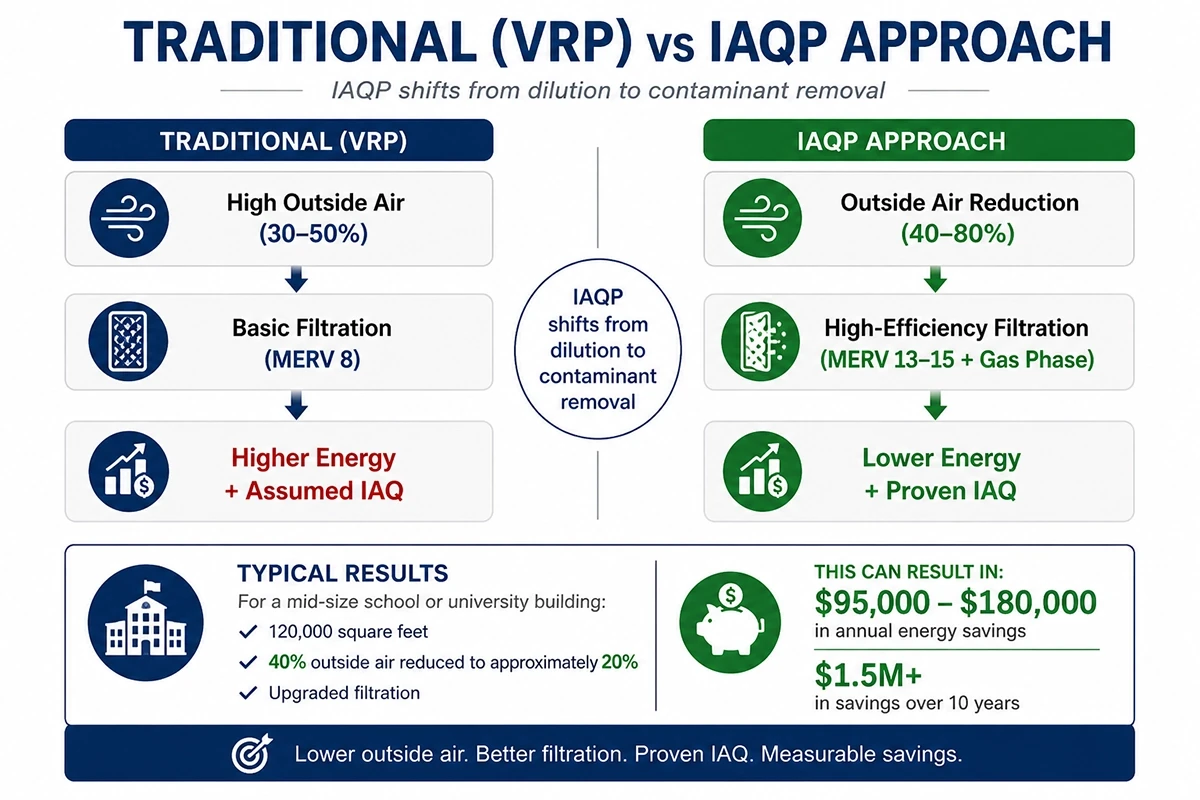
What This Looks Like in Practice – In many buildings, outside air can be reduced by 40-80% when applying IAQP. When combined with improved filtration and proper system control, the results often include:
- Reduced heating and cooling loads
- Improved humidity control
- Lower fan energy
- Reduced maintenance from longer filter life
- More stable indoor conditions
This represents one of the largest opportunities to
reduce HVAC operating cost in an existing building.
Typical Results – For a mid-size school or university building:
- 120,000 square feet
- 40% outside air reduced to approximately 20%
- Upgraded filtration
This can result in:
- $95,000 – $180,000 in annual energy savings
- $1.5M+ in savings over 10 years
Next Step: IAQP Feasibility Review
Most buildings can be evaluated quickly using a small set of inputs:
- Total airflow
- Current outside air percentage
- Filter type and performance
- Operating schedule
From this, it is possible to estimate:
- Outside air reduction potential
- Annual energy savings
- Long-term cost impact
- Indoor air quality compliance outlook
The IAQP Feasibility Review provides a Clear Understanding of what is possible for your building.
This includes:
- Estimated outside air reduction
- Projected annual and 10-year savings
- Preliminary IAQ compliance assessment
- Practical next steps
If you’re interested in understanding the potential for your facility, we can provide a quick, no-obligation evaluation.
- No disruption to your operations
- No upfront commitment
- Just clear, actionable insight
Determine whether your building may be a candidate for outside air optimization, reduced HVAC operating cost, and improved indoor air quality through IAQP and advanced filtration.

Call Us
(866) 586-4619
Email Us
info@lumin-air.com